Alice Glasnerová
Blogs:
2017
Thank you, Senator McCarthy: 18 Aug, 2017
Noel Field, soviet spy: 10 Sept, 2017
The
hunting dog finds a scent: 30 Sept, 2017
My past ghost: 24 Oct, 2017
Two worlds: meeting Alice for the first time: 26 Nov, 2017
2018
The London connection: 14 Feb, 2018
Stepping into the shadows: 13 March, 2018
Return
to the land of milk and honey: 22 April, 2018
Return to Czechoslovakia: 7 June, 2018
Dual
heritage: 18 June, 2018
Zilina, then and now: 1 July, 2018
A fateful triangle: Erwin, Noel Field and Alice: 29 Aug, 2018
Friends forever: 23
Oct, 2018
Lost luggage: 6 Nov, 2018
Questions of right and wrong: 20 Dec, 2018
2019
Letters from Alice: 26 Jan, 2019
A tale of two photographs: 1 March, 2019
In her father’s steps she trod: April 17, 2019
Prison visit: May 21, 2019
Cartoons and correctness: May 27, 2019
Visiting the dead: June 10, 2019
Alice in the archives: June 21, 2019
Dislocated worlds: May 12, 2019
Au revoir and not good-
Bienvenida Espana: 8 September 2019
Bullfighting in Albacete: 9 September 2019
Benicasim -
Surrounded by danger: 21 September 2019
Arrivals and departures: 29 September 2019
A place of execution (A cold afternoon): November 29, 2019
Seventy years on: 4 December 2019
Windows into the past: 10 December 2019
2021
Munich revisited: February 28, 2021
Will there be a Holocaust museum in Prague?: October 10, 2021
Statue wars: October 14, 2021
Transitional objects: October 21, 2021
My blogs
Dual heritage
June 18, 2018
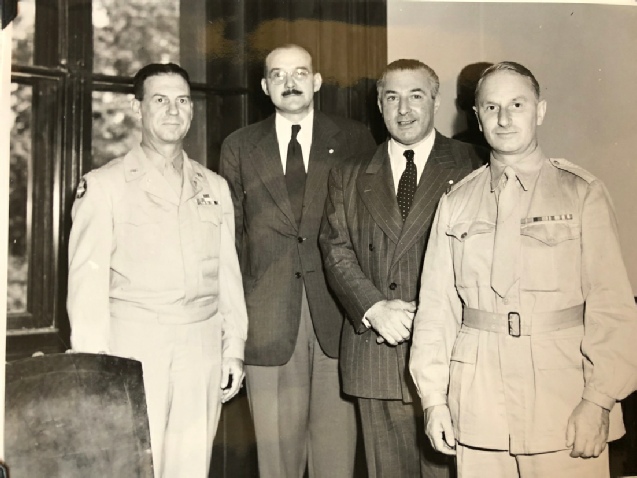
My father never drove; in my childhood it was always my mother who drove. She was the one at the wheel throughout our journeys across Switzerland, France and further afield. And our car, named Miranda, was a dark grey Mercedes. The sight of a German car in France was not a popular one in the 1950s and sometimes people spat as we drove past – ironic, in view of what my father and his family had suffered at the hands of the Nazis. But he still chose to have a German car because he believed they were the best. And every year we made the journey to our summer holiday destination – Austria, the Tyrol.
Erwin had a long and complex relationship with Austria; he studied in Vienna, completing a postgraduate degree there in 1928. Then, it was a city of contrasts, of conflict between the old and the new; on the one hand, the capital of a lost empire, on the other, a city filled with new ideas about psychoanalysis, art and music. And while he studied in one of the oldest and most respected of medical faculties (founded in 1365), all around him he was aware of changes, of innovation and questioning of the old and the accepted. For the son of a tailor from Zilina, it was exhilarating.
In 1947, he returned there to find himself challenging the very institution in which he had studied nearly twenty years earlier. Following the success of the medical teaching mission to Czechoslovakia, the Unitarian Service Committee, set up a similar mission to Austria, but the suspicion and sensitivities in Austria were of quite a different scale from those they had encountered in Czechoslovakia.
In a letter to Howard Brooks (Associate Director of the USC), Erwin describes the
mission’s early reception: “In spite of …. very elaborate preparations, we found
that a great deal of misinformation and a great number of misconceptions still existed
in Vienna until I personally arrived there on June 21st and until the main body of
the Mission reached Vienna on June 28th.” Erwin worked hard, once again, to dispel
doubts and suspicion, assuring the Austrian professors; “we approach our mission
of good-
However, although relations thawed in Vienna and later, in Innsbruck, the reception in Graz was very different. Dr Maurice B. Visscher, chairman of the mission and Professor of Physiology at the University of Minnesota, wrote a report in which he spoke frankly of his impressions:
“Nominally all Nazis have been purged. Actually it is impossible to do so. The man
who runs the medical school in Graz was said to be, by Dr Rak, Professor Leb. He
derives his power from his position in the Catholic, now called People, party. He
heads the Steirmark Medical division in that Party. Professor Artz in Vienna stands
in a comparable position in Austria as a whole. Leb is said to have been an SS officer
and a high Nazi. He is also said to be very anti-
Yet through all this, despite, at times, a cold reserve, and at others, outright
hostility, the medical team persisted and Erwin did his best to smooth over inconveniences
and difficulties. Unlike the Czechs the previous summer, Austria did not willingly
embrace the new opportunities and ideas offered. Another member of the mission, Dr.
Chester M. Jones, Clinical Professor of Medicine at Harvard, commented: “Energy is
directed towards holding on to what remains, rather than forward progress, either
in methods or in the utilisation of personnel.” He went on to describe the teaching
as impersonal and didactic and the staff at Graz as being “self-
These personally critical comments did not appear in the final published report on
the mission, but enough criticism was evident for Erwin to receive a letter of complaint
from Dr Wolfgang Holzer, Director of the Psychiatric-
“I cannot help feeling that the reasons for your sharpest rejection of the tone and contents of the report are to be sought in the differences in background that make some people so sensitive – or shall I say intolerant? – to the very type of criticism that others not only take for granted but would not like to do without.
We have found it time and again that the professor in many a European country enjoys
-
The young man from Slovakia who concluded his studies in these once venerable institutions
had become the middle-
Our last holiday in Austria was in 1962. One afternoon, when we went to wake him after his afternoon rest, we found him on the floor, his book upended, his glasses open and lost on the carpet. He had suffered a massive heart attack.
We could have returned his body to Geneva, but Austria was as close to home as he
was ever able to be. He was buried in a Tyrollean mountain graveyard in the small
section reserved for non-
Acknowledgements:
The Unitarian Service Archive at the Andover Theological Library, Harvard.